















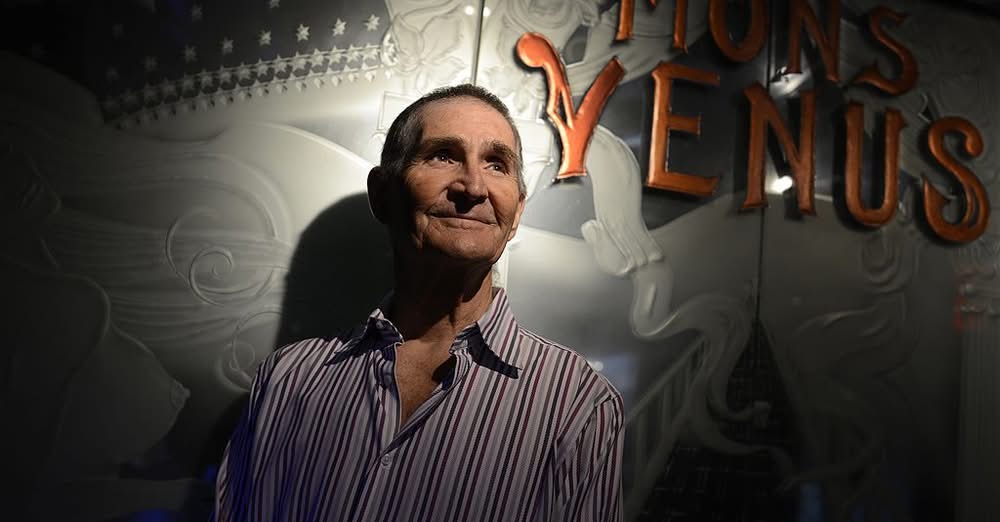

Far more than the “Father of the Lap Dance,” Mons Venus founder Joe Redner built a real estate empire, challenged Tampa City Hall and spent a lifetime fighting for free expression in all forms.
Sometimes you’d arrive at Mons Venus and find an unassuming old man sitting on the bench outside the front door, watching as groups of young men made their way inside. They came loud and restless, like a pack of libidinous wolves unleashed, hormones raging at the prospect of naked women just a few feet away. The old man said little. The young men had no idea who they’d just walked past. His gaze drifted toward Dale Mabry Highway, perhaps settling on the white Mercedes waiting to carry him into the night.
He knew he’d helped set the stage for these young men’s unforgettable evening, though the last thing he’d want was their thanks. Usually sporting a palm fedora and a loose-fitting Tommy Bahama, he’d climb into his car and drive off, content to let his club speak for itself. After half a lifetime spent trading blows with politicians, religious zealots and anyone else who thought they had the right to tell him what could happen inside those walls, Joe Redner had finally laid down his sword.


Let the boys have their fun.
Joe Redner turned Tampa’s adult nightclub scene into a proving ground for free speech, spending decades challenging the city’s authorities and transforming a little club with a funny-sounding name into both a strip club landmark and a battleground over personal liberty. Few figures in Tampa Bay history were as recognizable, controversial or consequential.
Redner, who died October 16 at 86, built an empire upon lap dancing, but his legacy extended well beyond the clubs. Entrepreneur, political candidate, public-access television host and relentless challenger of government authority, he made a career of refusing to take no for an answer.
And if you didn’t like it? Well, fuck you too.
Born July 2, 1940, in Hackensack, NJ, Redner moved to Tampa as a child and took an unconventional route into business. After working a variety of jobs, he entered the nightclub industry in the 1970s, first managing a go-go bar before opening Night Gallery, Tampa’s first all-nude club, off Hillsborough Avenue in 1976. The Tanga Lounge followed a year later along the Courtney Campbell Causeway.
As local authorities moved to tighten zoning restrictions and liquor licensing requirements, Redner responded by taking the fight to court. Those early battles helped establish his reputation as one of Tampa’s most outspoken advocates for free expression and adult entertainment, cementing his place as a formidable operator in an industry routinely targeted by local officials.
Then came Mons Venus.
Opened in 1982 on North Dale Mabry Highway, two miles from the field where the Buccaneers lose more than they win, the club became Redner’s signature enterprise and, alongside Busch Gardens and Clearwater Beach, one of Tampa’s most recognizable landmarks. Its success helped cement the city’s national reputation for nude dancing (the “strip club capital” line was always a myth), while its owner became a familiar presence in the ongoing struggle between club operators and regulators, especially former Mayor Dick Greco and councilwoman Ronda Storms, a noted LGBTQIA+ bigot.
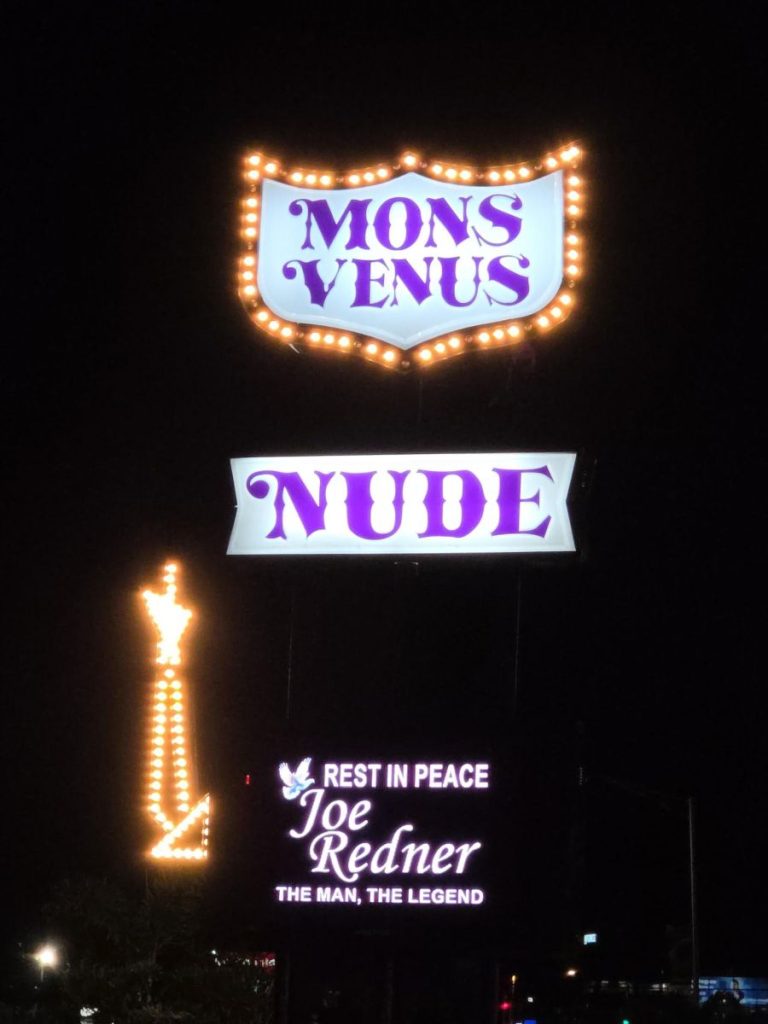
Police raids, arrests and courtroom battles became part of the operating landscape. Redner was once arrested four times in a single day alone. In the early 2000s, he continued fighting efforts to restrict full nudity with full contact, challenging ordinances he believed violated the First Amendment. But Redner was no businessman content to wage his battles from a courtroom. He studied the legal arguments, confronted elected officials and turned the Mons Venus marquee into a public weapon, needling politicians he considered his adversaries.
Alongside Redner for much of his civic good trouble was famed Tampa attorney and Exotic Dancer Hall of Famer Luke Lirot.
“It’s hard to say anything beyond the obvious, but he was really one of a kind,” Lirot says. “The word ‘iconic’ gets thrown around a lot, but when it comes to Joe versus the city of Tampa, it’s no less appropriate. He was a man beyond the words he spoke. He was all action. Fearless. The moments we shared, both big and small, were so special. I just liked to listen to the man speak. His mind was unique, truly, just wonderfully sharp. I will miss my brilliant friend.”
His fight was about business, certainly, but Redner consistently framed it as something larger: the right to express oneself without government interference. To his critics, he was a provocateur profiting from controversy, to put it kindly. To his supporters, he was an ally, someone willing to take the fight for civil liberties where few business owners would dare. And why not? He had the resources to do it: the money, the time and a big brass set of balls.
Redner carried that combative spirit into politics, running unsuccessfully for Tampa City Council, Hillsborough County Commission and other offices. His campaigns often served as another platform for challenging authority. He also co-hosted the public-access television program The Voice of Freedom, using local airwaves to discuss constitutional rights, civil liberties and government overreach.
His interests extended beyond adult entertainment. Redner helped finance Cigar City Brewing, founded by his son Joey, and owned the Tampa property where the celebrated craft brewery operated. The investment demonstrated a business acumen that could easily be overlooked amid the headlines generated by his more contentious ventures.
A 2009 documentary, “Strip Club King: The Story of Joe Redner,” captured Joe in all his loud, larger-than-life glory. Reviewing the film, Exotic Dancer Magazine called it “an honest portrait of a helluva complicated man,” adding that “whether you follow the footsteps of a First Amendment radical or demonize a walking controversy of adult entertainment, Redner’s biography is a classic tale of the American Dream.”
The review concluded with a prediction: “If this movie catches the mainstream’s attention the way it should, then the legend of Joe Redner will finally surpass the reputation of Mons Venus.”
Later in life, Redner took up another deeply personal fight: medical marijuana. After being diagnosed with Stage 4 lung cancer in 2011, he underwent treatment and enjoyed years of remission. He subsequently challenged Florida law to secure the right to grow his own marijuana for medical use. Although he won a court victory in 2018, the ruling was later overturned on appeal. The battle reflected the same independence that had defined his career: Redner wanted the freedom to make decisions about his own life, even when the law stood in his way.
In March of last year, Redner transferred operation of Mons Venus to longtime rival Don Kleinhans, owner of 2001 Odyssey, whose club stood across the street. The move brought Redner’s direct involvement in the club to a close while allowing him to retain ownership of the property.
“Such an incredibly sad loss for me, all of us and our industry,” Kleinhans said as news of Redner’s passing spread. “I was extremely fortunate to have Joe as a mentor, friend and competitor. He will be greatly missed.”
Redner was never a conventional businessman or an easy man to categorize. In his latter years, the passage of time had softened his words. His methods could be confrontational, his opinions provocative and his persistence exhausting to those on the other side of the argument.
For Bambi Wilde, the current general manager of Mons Venus, Redner’s influence was already legendary before she ever set foot inside the club.
“For me to talk about Joe Redner when I never met him feels disingenuous,” Wilde says. “However, I do know that the legend of Mons Venus was known to me long before I stepped inside. Everyone across this nation, when finding out I was a traveling feature and entertainer, would say, ‘Have you been to Mons Venus yet?’ The wildest, funniest and most interesting stories of the industry came from those conversations. So the legacy will never die.”

But for an industry accustomed to fighting for its place in the public square, his impact was undeniable. Joe Redner built a landmark, challenged the establishment and spent a lifetime insisting that freedom meant little if nobody was willing to fight for it.
Following Redner’s death, an outpouring of condolences flooded social media and local television news, and his passing made the front page of the Tampa Bay Times.
“I was just 20 years old when you placed your trust in me, giving me an opportunity that shaped the next 44 years of my life and allowed me to build a career, provide for my children and create a lifetime of memories and friendships,” says Vicki Marie Sedgwick-Baham, who worked alongside Redner since the Tanga days and served as Mons Venus’ general manager for much of the ‘90s through last year. Her son, Dan Baham, currently works as Mons’ head of security.
“As a kid, hearing my mother talk about Joe Redner, his tenacity, his intelligence and his determination, he was nearly a mythical figure,” he says. “When he gave me a job two decades ago, I was not disappointed, and he did not fall short of the tales I heard as a kid. The business that Joe built took care of me as a child through my mother, put both my siblings through college and, as an adult, allowed me the privilege of working for Joe in that same business. It has allowed me to build a good life and support my own child. I am grateful to him. It is my fervent wish that those of us privileged enough to remain at the legendary Mons Venus and care for his legacy do him honor.”