












(Note: This article was written by Luke Lirot and appears in the September 2026 issue of ED Magazine.)
Don Waitt was a visionary. His efforts helped organize an industry that was largely looked down upon, very controversial, very competitive, and viewed by many to be quite sinful, based on the fact that the “Exotic Dance Club” industry included the “EXPOsure of specified anatomical areas” as part of its theatrical business model. Don’s efforts have made this industry more unified, more respected, and much more successful. Don deserves major credit for contributing to the growth of this exceptional industry.

He was our teammate, our brother, and a solid example of what a dedicated, very bright, and highly motivated man can accomplish. This tribute isn’t just about the man we so unexpectedly and painfully lost, it is about how Don’s accomplishments helped improve this entire industry, and how his efforts solidly contributed to the protection of precious First Amendment rights.
Don and I had a lot in common. We were both Class of 1974 Catholic School graduates. We had both worked on newspapers, and obvious endeavor making one vigilant in the context of First Amendment issues. We were also both “civil rights” advocates. Don worked for the Shreveport Times, and, as one would expect from someone as exceptional as Don, he started as a “copy boy,” and then became a popular feature reporter. He also reported for the Orange County Register in LA. His writing was always brilliant and he was quite popular everywhere he “expressed himself” as a journalist.
I first met Don around the time he was launching Exotic Dancer Publications in 1991. He began with the publication of the Exotic Dancer Directory, a guide listing adult nightclubs throughout the United States and abroad. Over time, and after great effort, the early publications evolved into ED (Exotic Dancer) Magazine, a respected and amazing “trade magazine ” serving nightclub owners, managers, entertainers, DJs, vendors and other professionals working within the adult entertainment industry.
Don was also instrumental in establishing the Exotic Dancer Expo, the industry’s only national convention for the adult nightclub world, bringing together club owners, entertainers, DJs, security staff and other professionals, from all over the country.

Not only do we owe him homage, but from a more ‘patriotic’ perspective, every person in this country owes Don (Waitt) a debt of gratitude because his efforts in helping protect the First Amendment right of our industry helped protect the First Amendment rights of everyone.
— Luke Lirot
The EXPO experience has been taking place yearly since, and it has always included a magnificent tradeshow, seminars and panels dealing with a variety of legal and operational issues, parties, dance contests, and just an unparalleled upbeat social experience.
The first was at the famous Stardust in Las Vegas in 1993, and EXPOs have been held yearly for 33 years! There is absolutely nothing as much fun or that presents so many options to make new friends, gain education and socialize with others in the industry, all for the benefit of everyone involved. As I have said many times, there is no other industry with the level of challenges that we face, from misguided conservatives, religious fanatics, hypocrites and politicians. The challenges come from every direction, and Don helped unify us in a way that benefited everyone in dealing with these unending obstacles.
ED, the EXPO and the First Amendment
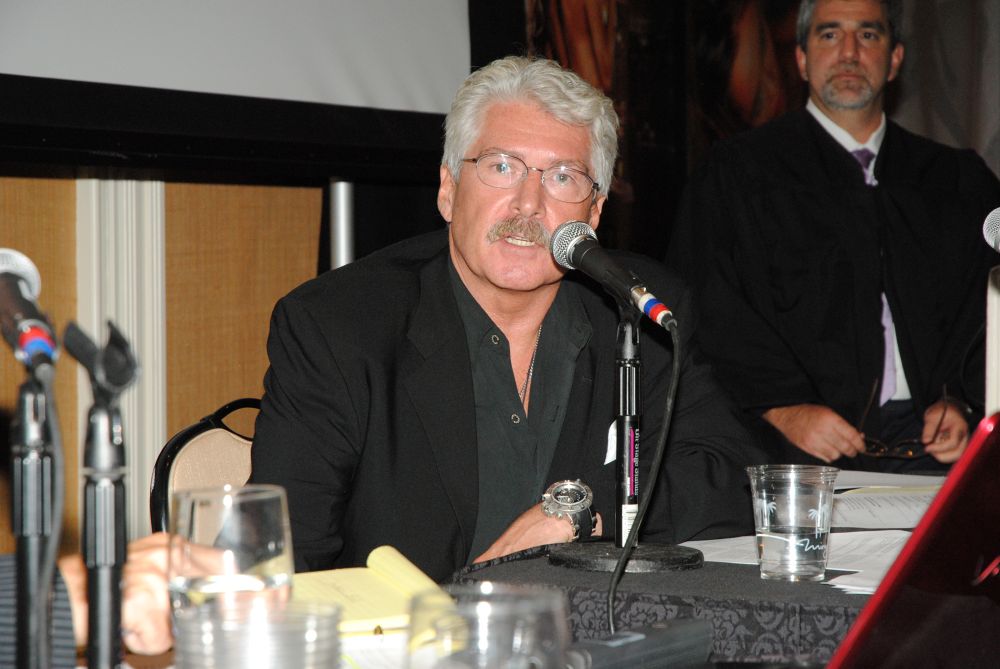
I had the pleasure to participate in the many legal panels that were held at the EXPO over the many years it has been ongoing. Usually, the underlying theme of these panels was how to protect the First Amendment rights of the industry. This was no small contribution. To understand the challenges in trying to protect and promote the First Amendment rights of this industry, it helps to understand the largely uninformed and biased way our courts have viewed this industry and how many judges have created such a challenging environment for us to survive in.
To get a taste of how we got where we are, the first time the Supreme Court opined on the First Amendment in the context of gentlemen’s clubs was in California v. LaRue, 409 U.S. 109 (1972). This case dated back to the times when “exotic dancing” was not much more than throwing a piece of plywood over a pool table to make a “stage,” long before the magnificent upscale facilities we have today.
Don’s ‘creations’ gave us the opportunity to work together as an industry to battle the blatant censorship and baseless restrictions that were imposed on us, with impunity, under the horrible ‘secondary effects doctrine,’ and the many other baseless efforts to harm our businesses and violate our First Amendment rights.
— Luke Lirot
The case got off to a good start, and the lower court struck down California’s regulations banning explicitly sexual live entertainment in bars licensed to sell liquor. That court found that the restrictions clearly violated the First Amendment, reasoning that the prohibited performances were not “obscene” and did not lack a “communicative element.”
The case was brought by the California Department of Alcoholic Beverage Control, who issued a “ban” after hearings revealing a sordid description of what I like to refer to as “patron focused expressive dance performances.” Since the case was originated by an agency responsible for Alcoholic Beverage Control, the Supreme Court ruled that the restrictions were valid under the 21st Amendment, which, in 1933, repealed the 18th Amendment and ended nationwide Prohibition, restoring states’ authority to regulate alcohol.
This “state authority” has been a fairly frequent weapon against clubs, and, in many cases I have handled, I have had to deal with the accusation that the “combustible combination of testosterone and ethanol” justifies a denial of our First Amendment rights. This is inane, but it has been a consistent tool supporting outrageous legislative limitations on someone’s desire to pursue “life, liberty, and happiness.”
After California v. LaRue, the Supreme Court delved into even more creative fictional justifications to try and limit both the location and operation of Clubs. Back in the early 1970’s, the City of Detroit decided to eliminate adult theaters from parts of town through the adoption of an “anti-skid row” ordinance. The restriction was clearly “content based” and a clear violation of First Amendment rights, but the Supreme Court said such a bogus restriction would be valid if it was aimed at the so called “secondary effects” of adult businesses.
The case was Young v. American Mini Theaters, Inc., 427 U.S. 50 (1976). The “secondary effects” identified in the Young case were based on the belief that the concentration of the businesses sought to be regulated by the City of Detroit in its “anti-skid row” legislation “tends to attract an undesirable quantity and quality of transients, adversely effects property values, causes an increase in crime, especially prostitution and encourages residents and businesses to move elsewhere.” The honest Justices were overwhelmingly critical of this clear First Amendment violation, but they were in the minority, so we have been stuck with this ridiculous sophistry for decades.
The next important case was City of Renton v. Playtime Theaters Inc., 475 U.S. 41 (1986). Again, the Renton case recognized that any zoning restrictions placed on businesses deemed to be “adult entertainment” would be unconstitutionally “content based” unless the zoning ordinance at issue was designed to prevent crime, protect the city’s retail trade, maintain property values, and was otherwise the result of “predominate concerns” with the secondary effects of adult businesses and not with the content of adult entertainment itself.
The problem with Renton was that the City was just trying to prevent (as in “prior restraint”) an adult theater from opening. The City tried to satisfy the “secondary effects” issues by “borrowing” so-called evidence of problems from a number of other sources. The Supreme Court allowed this “evidentiary transgression” to support the ordinance. Indeed, in upholding the ordinance at issue in Renton, the Supreme Court held that, “the First Amendment does not require a city, before enacting such an ordinance, to conduct new studies or produce evidence independent of that already generated by other cities so long as whatever evidence the city relies upon is reasonably believed to be relevant to the problem that the city addresses.”
The big issue is that most of this “other evidence” that the government repeatedly relies on is manipulated garbage, purposely designed to assert fatally flawed research methodology as a basis to support the censorship and restrictions that many Cities simply want to pursue. There have been hundreds of court challenges, many based on these frustrating precedents, and these were frequently discussed and explored in ED Magazine and during many EXPO panels.
Don’s “creations” gave us the opportunity to work together as an industry to battle the blatant censorship and baseless restrictions that were imposed on us, with impunity, under the horrible “secondary effects doctrine,” and the many other baseless efforts to harm our businesses and violate our First Amendment rights.
As the years have passed, there have been a multitude of cases involving our industry pursued in state and federal courts. In Barnes v. Glen Theatre, 501 U.S. 560 (1991), a very old Indiana statute prohibiting public nudity was challenged. Painfully, the Court ruled that the state had the authority to regulate nudity in public places without violating the First Amendment. The case involved two adult entertainment establishments in South Bend, Indiana: the Kitty Kat Lounge and Glen Theatre. Both had dancers who wished to perform completely nude. The dated Indiana statute mandated that performers must wear, at least, “pasties and G-strings” (sound familiar?).
Initially, the lower court ruled in favor of the businesses, granting an injunction against the enforcement of the statute, finding that nude dancing was protected under the First Amendment. The Seventh Circuit Court of Appeals reversed this decision, finding that, while nude dancing is expressive conduct, the state has a legitimate interest in regulating public nudity to maintain “public order and morality.” How “pasties and G-strings” help maintain “public order and morality” seems like a ridiculous stretch, but the Supreme Court agreed. I am still trying to figure out how “pasties and G-strings” can promote “public order and morality.”
The case of City of Erie v. Pap’s A. M., 529 U.S. 277 (2000), involved an ordinance making it a summary offense to knowingly or intentionally appear in public in a “state of nudity.” The ordinance was targeted by Kandyland, a nude club operated by Pap’s A.M. To comply, dancers had to wear at least “pasties and a G-string.” Again, giving short shrift to the First Amendment, and having such gems in the decision that, even if the City’s motive was illicit, the ordinance was constitutional on its face (Concurrence: Scalia, joined by Thomas).
The dissent again EXPOsed the major problems with all of the “secondary effects” cases: the City failed to show that the harm was directly caused by the expressive activity and the ordinance was not reasonably designed to address a concrete problem (Dissent: Stevens joined by Ginsburg). The one useful component was that the Erie case gave clubs a shot at challenging the so-called evidence upon which these censorial ordinances were based:
“Here, Kandyland has had ample opportunity to contest the council’s findings about secondary effects before the council itself, throughout the state proceedings, and before this Court. Yet to this day, Kandyland has never challenged the city council’s findings or cast any specific doubt on the validity of those findings. Instead, it has simply asserted that the council’s evidentiary proof was lacking. In the absence of any reason to doubt it, the city’s expert judgment should be credited.” Justice O’Connor, joined by Justices Kennedy, Rehnquist, and Breyer. (Emphasis added).
As the Courts and various misguided communities continued to attack fully licensed, clean, upscale and spectacularly designed and operated Gentlemen’s clubs, Don was instrumental in helping form ACE (the “Association of Club Executives”). Created in 1999, ACE National is a trade association representing the country’s adult nightclub industry. The organization serves the industry by providing valuable resources, great business benefits, important information, legislative updates, and a solid voice on issues affecting adult entertainment businesses. ACE also devotes resources to challenge the endless misinformation concerning legally operating clubs, their employees, entertainers, owners and patrons.
In 2009, ACE progressed into creating COAST (Club Owners Against Sex Trafficking), which provides extensive training to the industry to address the issues of human trafficking. Led by law enforcement, each outreach teaches ACE members and industry workers about the problem of human trafficking within their communities, and the steps a COAST attendee may take to recognize and report suspected problems. Since its inception, COAST has educated over 20 thousand adult nightclub industry professionals about the crime of human trafficking. COAST hosts anti-sex trafficking training seminars throughout the U.S. and is incredibly well-respected.
If we look at ED Magazine, the EXPOs, ACE, COAST and the over 30 years of opportunities that Don Waitt helped make available to the gentlemen’s club industry, it is hard to imagine where we would be had he not focused his incredible talents on us. His efforts helped protect and promote this industry beyond anyone else. Not only do we owe him homage, but from a more “patriotic” perspective, every person in this country owes Don a debt of gratitude because his efforts in helping protect the First Amendment right of our industry helped protect the First Amendment rights of everyone.
We lost Don way too soon and we owe it to his memory to carry the torch and be vigilant and passionate in doing everything we can to prevent any opponent from doing violence to the First Amendment, protect our industry and honor Don through our commitment to that all-important mission.
For more information, contact attorney Luke Lirot at luke2@lirotlaw.com.