


















In this recap of this year’s “Owners & Entertainers” EXPO seminar, three industry veterans, Tami Alana-Miller, Bambi Wilde and Justice, discuss how clubs and entertainers can build a better working relationship.
(Note: This article appears in the November 2026 issue of ED Magazine.)
Few relationships in the adult nightclub business are more important, or more complicated, than the one between entertainers and the clubs where they work. Entertainers are often the first point of contact between a customer and a club, while the club provides the environment, infrastructure and clientele that allow entertainers to build their businesses. When the relationship works, everyone benefits. When it breaks down, the effects can reach far beyond hurt feelings, affecting morale, customer service, revenue and ultimately the health of the business.

That relationship was the focus of a 2026 ED EXPO seminar, “Owners & Entertainers: Improving the Vital Relationship,” moderated by ED Publisher Dave Manack. Joining him were Tami Alana Miller, regional director for Deja Vu; Bambi Wilde, general manager of Mons Venus in Tampa and a former entertainer; and Justice, a feature entertainer, former club manager and contributing writer.
The panel addressed communication, professionalism, club culture, safety, house fees and customer relationships. Its central message was simple: Clubs and entertainers need each other.
(Editor’s Note: The following is an edited and condensed portion of the seminar. The full discussion was longer and has been shortened for space.)
The vital relationship
MANACK: We hear that the relationship between management and entertainers is sometimes toxic. Has it gotten worse?
TAMI: I think it’s always been difficult, but it has become more toxic. Social media is a big part of that, along with entertainers realizing they are independent entrepreneurs inside our business. There has to be respect on both sides. We have a job to do as operators and they need to respect that boundary as we respect theirs.
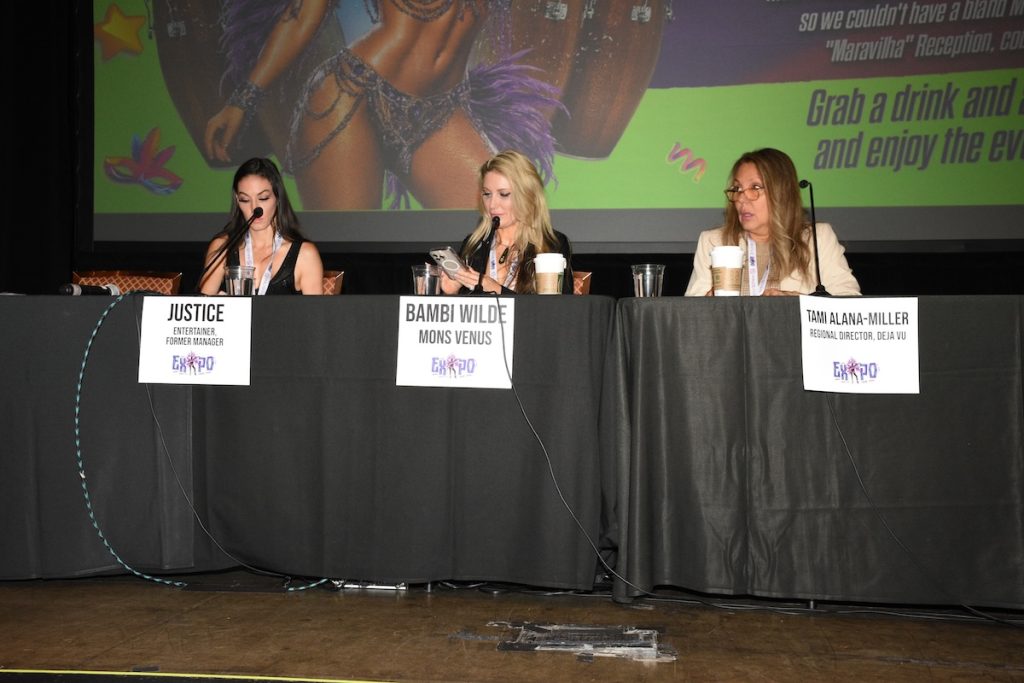
BAMBI: It depends on where you are and who is leading by example. I’ve seen clubs hurt morale because of management decisions, but I’ve also seen clubs with poor entertainer relations turn things around with the right leadership and communication.
JUSTICE: There has to be respect between management and entertainers. If there is no communication between staff and entertainers, no one can get anything done. A toxic environment where women feel everything is combative or competitive isn’t healthy for anyone.
MANACK: How important is communication?
TAMI: Communication is the biggest factor in the relationship between managers and entertainers. When communication is poor, people make assumptions. Expectations need to be clear. Rules need to be clear. You’re both trying to operate a business within four walls, so you have to communicate.
BAMBI: Entertainers don’t need to know every detail of how the club is run, but they do need to understand changes that affect them and why things are done a certain way. They need to be part of the conversation so they understand we’re all on the same team. If they’re not making money, we’re not making money.
JUSTICE: Good communication means more than having a staff meeting once a month. Entertainers need a safe place where they can go to management if they’re having an issue. The rules also have to be consistent. You can’t tell one entertainer no and another yes because she’s making more money. Happy dancers work harder. You need an environment where women feel valued.
“Happy dancers work harder. You need an enviroment where women feel valued.”
— Justice
What entertainers need to know
MANACK: What do you wish entertainers understood about clubs and management?
TAMI: Recognize the value of what you bring to the club, but recognize that you’re running a business too. You have to show up prepared and be professional. I hate seeing entertainers walk in wearing pajamas and slippers. You’re walking through the club and guests see you. You’re part of the fantasy. Take care of your guests and realize you’re building relationships. The club gives you a platform and an opportunity, but you have to build your own business. Don’t assume management is the enemy. If you have a problem, talk to management. Don’t let frustration turn into a huge conflict. Deal with it immediately. Don’t gossip or tell guests about your problems. Operate it as a business.
BAMBI: We need each other. It’s a symbiotic relationship. If you’re happy, we’re happy. Happy dancers work harder and make money. The club’s job is to provide an inviting and safe workplace. Entertainers should also look at themselves as a brand. Some are phenomenal performers. Others don’t like the stage but are exceptional at getting dances. We need all of them.

JUSTICE: I would tell entertainers a harsh truth: You’re part of a team. Come in with a great attitude. Leave your baggage at home. Work hard, have fun and put a smile on your face. Don’t complain to customers or staff. It’s not always about the guy throwing a bunch of dollar bills. It’s the everyday guy who comes in regularly. A simple, “Hi, how was your day? My name is Justice. Can I sit with you?” goes a long way.
MANACK: The most successful entertainers don’t get paid simply to take their clothes off. They get paid to listen to men. The better you are at making customers feel wanted and good about themselves, the more valuable you become.
What club operators need to know
MANACK: What should owners and operators understand about entertainers?
TAMI: Don’t underestimate the importance of an entertainer. They are one of the reasons customers come. They’re independent entrepreneurs running their business inside yours. If you want them to invest in your club and give their best, they need to feel valued. At Deja Vu, we have recognition programs and mentorship programs that help new entertainers learn how to be professional and succeed. You have to listen to them. Build trust. Communicate. Recognize their contributions and hold everyone accountable fairly. You can’t have one set of rules for one entertainer because she’s making more money.
BAMBI: Entertainers are under no obligation to stay with you if they’re unhappy. Happy, beautiful entertainers are one of the biggest assets we have, and they can go anywhere.
I’ve heard managers tell entertainers they’re replaceable or disposable. But entertainers talk to each other, and social media has changed that. The more you treat entertainers like they’re unimportant, the less they want to work for you. Programs are important, whether they’re workshops or helping entertainers learn how to maximize their time and income. Even having a clean, safe dressing room matters.
“The club gives you a platform and an opportunity, but you have to build your own business.”
— Tami Alana-Miller
JUSTICE: Dancers are not a dime a dozen. A really good entertainer can be a huge asset to your club. I’d also like to address house fees. If you’re making all of your money based on house fees, we need to look at different options. There are entertainers who are afraid to work at certain clubs because they’re paying $120, $150 or $200 a night. I’m not saying you have to lower your fees. I’m saying you have to look at the bigger picture. If you’re struggling to get women in on a Monday, Tuesday or Wednesday, maybe there is some flexibility that encourages them to come in because they can make money.
TAMI: I understand the house fee argument, but entertainers also need to understand that clubs have expenses. Cleanliness, safety and maintaining a nice facility don’t come for free. It’s a balance.
Building a better club culture
MANACK: What have you done to improve relationships with entertainers?
TAMI: I listen. Sometimes it’s easier for entertainers to approach a woman and express concerns. Sometimes they just want to be heard. I give them a safe space and value them as business partners. I communicate with them on every shift. I compliment them. Everybody likes to feel appreciated.
BAMBI: At Mons Venus, we added a Wednesday workshop. Initially, I taught it myself. We did pole and hustling 101, and it was open to all entertainers at no cost.
Eventually, it expanded. Now we coach entertainers on pole, getting dances and talking to people. You can’t force anybody to participate. You offer it. It’s helped morale and helped entertainers make money.
JUSTICE: At one club, we were starting a day shift, so I offered an incentive for entertainers to come in during the day. I taught them everything I could, from pole to marketing themselves. I also did a Sunday supper and organized charity events to bring people together. I was basically a cheerleader for the girls. Positive reinforcement.
MANACK: Another idea is giving entertainers conversation points before their shifts. If you have a 21 or 22-year-old talking to a man in his 40s or 50s, she may not know where to start. Give entertainers something to talk about. There might be a big football game or something happening locally. Sometimes you just need to give them an opening beyond, “Want a dance?”
Questions from the floor
QUESTION: How do you convince entertainers that there is a long game and that this isn’t about instant gratification?
BAMBI: You have to encourage them to understand that you want the customer to leave with an empty wallet but a smile on his face. It’s about taking care of him rather than squeezing everything you can out of him in one night. If you take care of him, he’ll come back.
QUESTION: What do you do with an entertainer who steals from customers?
JUSTICE: You need to fire her.
TAMI: Immediately.
BAMBI: You have to make an example of that behavior. You can’t accept it. That’s straight up theft.
QUESTION: Mental health is extremely important in the adult industry. Do you provide resources?
BAMBI: Absolutely. It’s important to have phone numbers, websites and contacts you can offer entertainers. Managers can listen and be available to talk, but sometimes issues go beyond what we’re capable of dealing with. Clubs should have resources available.
QUESTION: What about oversaturation?
TAMI: I don’t think you can ever have too many entertainers.
JUSTICE: It’s about having the right entertainers. You can have 100 women on the floor, but if they’re great entertainers with great attitudes, happy to be there and good with the clientele, that’s what matters.
MANACK: And ultimately, that’s the point. The best clubs understand that entertainers aren’t simply an expense or a commodity. They’re a critical part of the product.
For more information, visit theedexpo.com.