













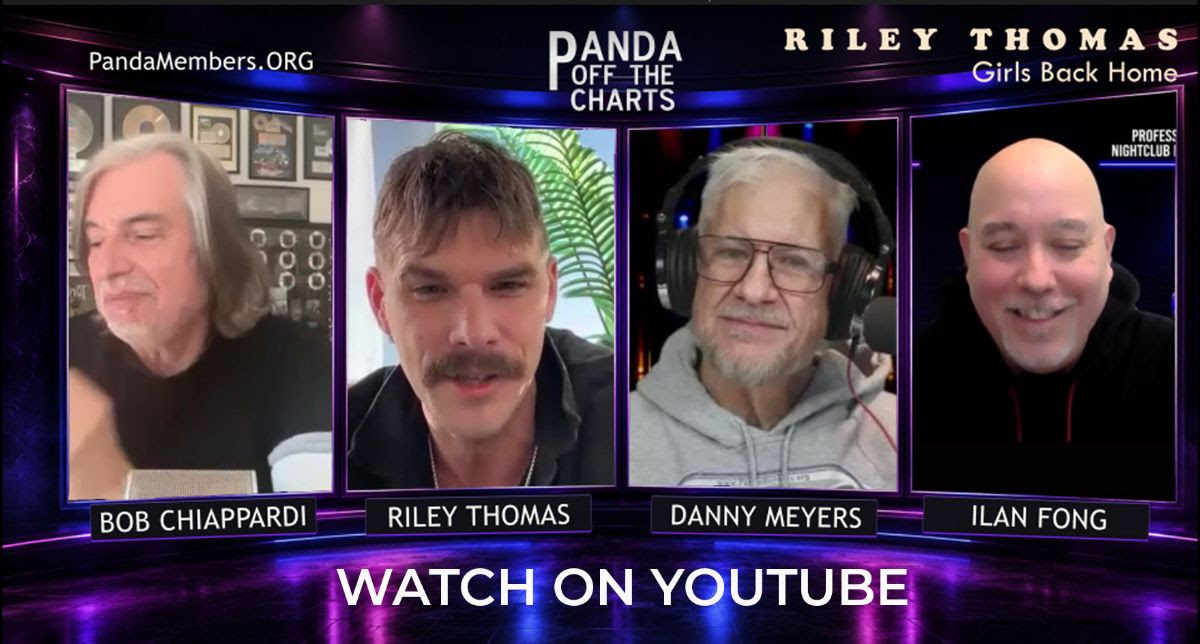

Riley Thomas grew up in Plant City, Florida, playing baseball and singing in church before a Christian rock band took him to Nashville. On an episode of Panda Off the Charts, the country-rock singer-songwriter tells Danny Meyers, Ilan Fong and Bob Chiappardi how the girls along Florida’s Highway 60 inspired his single “Girls Back Home,” what it was like to co-write “Kill a Man” with Jelly Roll and how a hangover helped him find a new way to sing Train’s “Drops of Jupiter.” He also explains exactly what he meant when he went looking for a little “stripper guitar” in the studio.
MEYERS: This is Panda Off the Charts for November 2026. Today I’ve got a guest who’s Florida-born and Nashville-based. He’s a country-rock singer and songwriter, Riley Thomas. Riley, how are you?

THOMAS: So good, boys. How y’all doing today?
MEYERS: Doing great. The song you’re promoting right now is “Girls Back Home.” Is it about a Florida town or more of a generic backwoods town?
THOMAS: I’m from Plant City, Florida, which is a strawberry town. We’re very close to Highway 60, which runs right through Tampa and Brandon. I’m really speaking about the girls who are from that corridor. When I have an idea like this, I put multiple states in the verses. There are different places I’ve visited, and the song could be for you if that’s where you’re from. But for me, the inspiration comes from my dirty little swamp town in Florida.
MEYERS: Very cool. I also found out that you wrote a song for Jelly Roll, right? “Kill a Man.” Did you co-write that?
THOMAS: That’s exactly right. Sure did, man. Did it with him in the room, too. That was fun.
MEYERS: What’s he like?
THOMAS: Man, he’s out of his mind and very cool. When I walk into the room, there’s a buffet of food everywhere, and anything you partake in might be there as well. I’ve got a bunch of good buddies in Nashville, and we’re all co-writers, so there’s a lot of support for getting those sessions together. He’s a good guy. He’ll learn a lot about you, and he starts to care about you pretty quick, too. Once you’re in, you’re in with Jelly.
MEYERS: Bob, that’s your next project. Get Jelly Roll as our next guest.
CHIAPPARDI: I’m in the middle of trying to get him on the Steve Cropper record I’m putting together. We’re trying to get him to do “(Sittin’ On) The Dock of the Bay.”
FONG: We’ll have Riley put in a good word for us.
THOMAS: I’ll catch him on the golf course or something.
FONG: I was reading about you, and here’s what I found interesting. You played baseball until you were 14, and Florida is highly competitive in baseball at that age, so you must have been pretty damn good. Somewhere along the line, you switched to music. You played in a Christian rock band, Among the Thirsty, and now you’re doing songs like “Cowboys Do Cocaine.” Those are two pretty big shifts. What changed for you when you went from sports to music, and then from Christian rock to what you do now?
THOMAS: It sounds complicated, but I played sports since I was a kid. I was real tall and lanky, so I could sling a ball pretty quick. I loved doing that, and I was really good, but baseball was never really my passion. I’m from a small strawberry town, so anything you can do to get out of town is what you latch onto.
I grew up singing in church. That’s how a lot of people learn they have a voice. Once I started playing guitar, I started talking to a lot more girls. Maybe I was a better guitar player than I was a baseball player. Either way, I was like, “Well, this is probably the thing I need to do most.” I always had a passion for it, and tons of artists inspired that decision.
As a teenager, I was up for joining a band, whether it was Christian, rock, or whatever. I’d say, “Hey, if you guys have the hot hand, I’ll ride with you.” That led to three years of playing Christian rock. Then the band moved to Nashville, Tennessee, where I live now. I thought, “If that gets me out of town, that’s exactly what I’ll do.” Once I moved to Nashville, I was no longer in the band, but I started writing songs full time. I’ve been in and around Nashville since 2012.
The baseball dream died. I watch it, and maybe I’ll do a little betting here and there, but I leave that to the real professionals. I sank my teeth into songwriting, and the songs I have now came from years of learning my own style. The Christian rock circuit led me to a bunch of really good musicians in Nashville. I learned songwriting was my real passion, and as far as performing goes, I always wanted to live and die on the stage. That’s what got me here.
FONG: Is there anyone you model yourself after onstage, whether it’s your stage persona or the way you sing and play guitar?
THOMAS: Man, if I could be Robert Plant and Jimmy Page as one person, that would be it. They’re just gods among men, dude. I’ve heard Led Zeppelin in a club here or there, too. Those are probably my biggest idols because I love the style. I love how massive a production can be and how mean it can be, too. Once you start rocking, you just keep going. The crowd tends to go there with you.
MEYERS: Bob, you’re in Nashville, and Riley’s in Nashville. Have you guys ever met?
CHIAPPARDI: We haven’t crossed paths before. This is our first time meeting.
THOMAS: First time meeting, man.
CHIAPPARDI: I imagine it won’t be our last. We’ve got a lot of fun things going on that we’ll have to invite you down to. Danny hosts the EDIs, the Exotic Dancer Invitationals, down in Huntsville every year. We always look for celebrity judges.
FONG: Vinnie Paul from Pantera, rest in peace, has done it. We’ve had others, too.
CHIAPPARDI: That’s next spring, so we’ll have to get you down there for that.
RILEY: It’s not too far away, either. I’m sure we can make that happen.
FONG: I love your voice. I come from more of a rock background, and to me, a lot of male country singers have a limited range, so you don’t get those dynamics. You have really good range. In that little clip, I could tell you could really sing. I like the change from the country verses to the hardcore rock chorus with all that crunch.
Before we played the song, you talked about rock having a darkness to it, an edge, an anger. I can feel a little of that darkness in your music. There’s a weight to your voice and the way you present your music that a lot of other country-rock artists don’t have. It feels like an inherent part of who you are as an artist, which is hard to pull off.
THOMAS: I really appreciate you saying that. It’s hard to perform it, and it’s almost as hard to convince other people that the sound exists.
FONG: I feel like a lot of people put it on, and it comes across like they just wanted to do an angry song. Your song has this darkness that makes you go, “Wait, there’s more to this than pretty girls back home.” This isn’t Luke Bryan or somebody doing it. Very cool track. I got to listen to three or four of your tracks and dug them, man. I’m not a huge country fan, but there’s stuff I like.
THOMAS: I grew up on classic country with my father. He was a sniper in the Marine Corps and loved a lot of classic country. George Jones and Dwight Yoakam are big ones for me. As soon as I could play guitar, though, I started playing rock ’n’ roll. That was it for me from the first moment. The country might be baked in because I’m a farm-town kid. You almost get the country for free when I’m making music because both are part of who I am.
FONG: You feel like a rock artist with elements of country in you. There’s this big rock-country crossover happening in the mainstream right now, and some of it feels like people borrowing from ’80s classic rock or hair metal. Your sound feels baked in. It sounds like something that’s going to be there throughout your career.
THOMAS: Absolutely. I appreciate you hearing that, man.
MEYERS: You’re a multi-instrumentalist. Did you play all the instruments on this song?
THOMAS: I played everything but drums. My buddy Grady played drums, and he’s a phenomenal drummer. He plays on a lot of country and rock records. I do some production here and there, so I programmed a beat and said, “I want you to go hog wild on me.”
My buddy Nathan, a session musician in Nashville, came into the studio to play guitar. I already had big, heavy guitars, but I needed a little ripping. Other than me and my producer, Bayless, Nathan was the guy who played guitar on it. What I wanted, and this is going to sound hilarious, was stripper guitar. I thought of so many references and went, “Man, it’s not going to hit home where I want it to without these big, ripping, soaring leads.” So we sat there, passed the guitar back and forth, and came up with the naughtiest shit we could.
FONG: Bob Chiappardi loves that. He calls it the grind sound. It’s a guitar tone that hits you in your loins. It starts warming up right there in that chakra. Speaking of great drum sounds, I just listened again for the first time in years to that Mötley Crüe record with John Corabi singing that Bob Rock produced. I forgot how great those drums sounded. Do you know the album?
THOMAS: I know it well.
FONG: Tommy Lee’s drums sounded massive.
THOMAS: They’re enormous. I’m pretty sure they’re about that big around when you see them in the studio, too.
FONG: That’s my favorite drum sound of all time.
THOMAS: It’s awesome. What a great reference, man. That’s sick.
MEYERS: I was going through some of your other songs on Spotify, and there’s a cover that floored me. Ilan, if you haven’t heard it yet, you’ll know it in a heartbeat. Riley recorded Train’s “Drops of Jupiter,” which has always been one of my favorite songs. Of the songs I heard from you, that one was amazing. Did you do it a while back, or was it recent?
THOMAS: When I was making this record with “Girls Back Home” and all these singles, I was in a writing room with my best friends, Andrew Bayless and Michael Whitworth. We’d been drinking a little bit the night before. We woke up, I had a guitar in my hands, my eyes were probably closed, and I had a migraine. We were about to write all day again, and I was feeling more like playing in a minor key.
I played a chord and thought, “That kind of sounds like Train for some reason.” Maybe it was because I was so damn hungover. I started singing the chorus in the key you hear on the recording, and they looked at me and said, “You’ve got to do that, dude!” I think I did it last year. I’ve always loved that song, but when I put it in a minor key, I thought, “Somehow it sounds like it’s mine when I do it like that.”
FONG: I was previewing stuff on Spotify and skipped halfway through to try to find the chorus. You were singing with more of a gravelly voice, and I didn’t recognize it until the chorus clicked. I thought, “Okay, it is ‘Drops of Jupiter.’” I’m a singer, too, and I noticed how softly you sang the verse. It’s a really clean, pretty part of your voice, and then you can add that vocal fry whenever you like. It sounds great.
THOMAS: I appreciate that, dude. I obsessed over making it sound just like that. I’m glad it comes across because that’s exactly the way I felt about it when I tracked it.
MEYERS: Bob, as of this recording, “Girls Back Home” has been out for five days. It officially came out on November 13. How did it get on your program, and where can DJs get it?
CHIAPPARDI: I got it through Riley’s manager, Scott, who’s been a friend of mine for decades. We go back to the hard-rock days, with bands like KISS and Skid Row.
FONG: Once you said Skid Row, I thought, “Oh, that’s got to be Doc McGhee.”
CHIAPPARDI: Exactly. Scott invited me down to see Eddie.
THOMAS: Eddie and the Getaway, yeah.
CHIAPPARDI: We got to talking, and he said, “I’ve got a song you’ve got to hear for your strip club program.” I said, “Send it.” He sent it, and I thought, “This is perfect. I love this.” We got the song from Scott today, and it’ll go out tonight. By the time you hear the show, it’ll be in the inboxes of 615 strip club DJs.
THOMAS: Let’s go. Very cool.
MEYERS: Before we wrap up, I understand you’re setting up a tour for 2027. What have you got planned?
THOMAS: I’ve got some buddies in a band called Lakeview. A little shameless plug for them because I love them, and I wrote their latest single, “Wreck My Night.” They’re some of my very best friends. They come from a hardcore background, and they’re right in that heavy country slot. That might be the best way to put it.
We’ve been doing a lot of stuff together. Our first show together is February 18 at The Basement East here in Nashville. We’re going to have a rowdy one, and we’ll be doing more stuff together throughout the year. If you’re in Alabama or anywhere nearby, come through. I think it’ll sell out, and it’ll be a hell of a show.
FONG: We’ll have to drive down for that show.
MEYERS: What’s the best way to follow you and see your tour schedule when it’s published?
THOMAS: I’ll be sending things out daily on Instagram and Facebook. It’s the same handle on every profile, @TheRileyThomas. If it says The Riley Thomas, it’s me. It’ll probably have a little check by it. We pay a lot of money for that.
MEYERS: I think you’re going to get three new requests as soon as we’re done recording. Is there anything else you want to plug before we let you go?
THOMAS: Let me just thank you guys for what you do. I’m new to the program, but I’d love to be a returning friend of the show. I love that this association does so much for nonprofits and other people, and keeps the community together. Thanks for having me on. I appreciate working with you guys, and I’d love to do it again.
MEYERS: Remember this name, Riley Thomas. We meet a lot of new artists, and this dude’s got it, man. Capital I-T. I wish him so much luck. He seems like a really nice guy, too. Bob, good find bringing him on and getting him on your program.
CHIAPPARDI: I was thrilled to have him on. He’s a Nashville boy, so I’m looking forward to hanging out with him in the future.