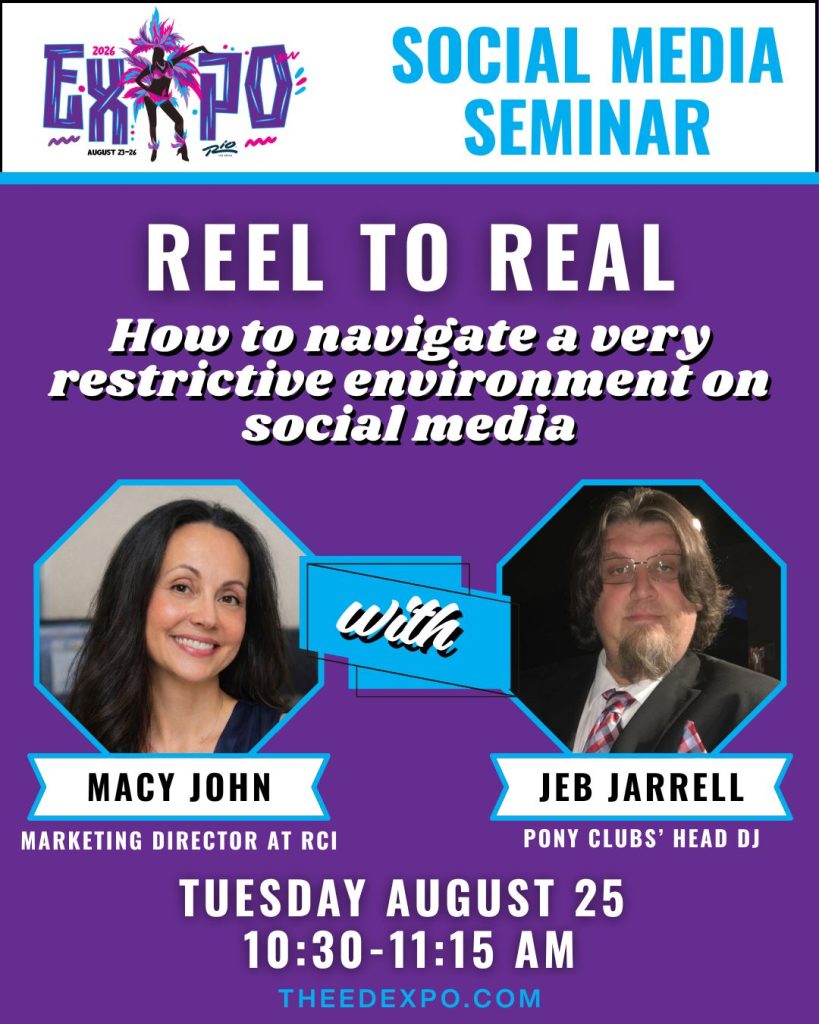















In this 2026 ED Expo seminar preview, Macy John and Jeb Jarrell discuss the impacts of Meta’s automated content moderation and the simple AI solutions that can help clubs avoid violations. EXPO attendees can catch their seminar “Reel to Real: How to Navigate a Very Restrictive Environment on Social Media” on Tuesday, August 25, at 10:30 am.
As it is for most businesses, social media is one of the adult nightclub industry’s most powerful marketing tools. While clubs and entertainers could once promote events without pushback from Meta as long as they abided by content guidelines, something has changed over the last two years.
“We started noticing a significant increase in account shutdowns in 2024,” says Macy John, Marketing Director for RCI Hospitality Holdings. “It was regional at first. Around eight clubs in Texas were hit on the same day. Then every few weeks it would hit New York. By 2025, it was all over.”

According to John, these changes were a direct result of massive layoffs affecting content moderators after Meta developed its automated content review system.
“Before that, clubs could run Facebook and Instagram pages with relatively few issues as long as they followed Community Standards,” she continues. “If something got flagged, a person was usually making the final decision.”
Now, Meta’s automated review system is aggressively enforcing guidelines by removing content and restricting accounts, many of which aren’t in violation of the platform’s guidelines. Without warning, millions of accounts have been suspended, cutting businesses off from communicating with their customers.
“The appeal process is also heavily automated,” John adds. “If your account is already flagged or compromised in Meta’s system, it can be very difficult to get a real person to look at it, and many accounts end up permanently banned.”
While Facebook and Instagram are both owned by Meta, John says the platforms don’t operate the same way.
“Facebook doesn’t seem to rely on AI as heavily as Instagram,” she explains. “Most of Facebook’s content is groups, discussions, links and text used by an older audience. Instagram is almost entirely images and video used by a younger audience. Because of that, Meta has taken a much more aggressive approach on Instagram than on Facebook.”
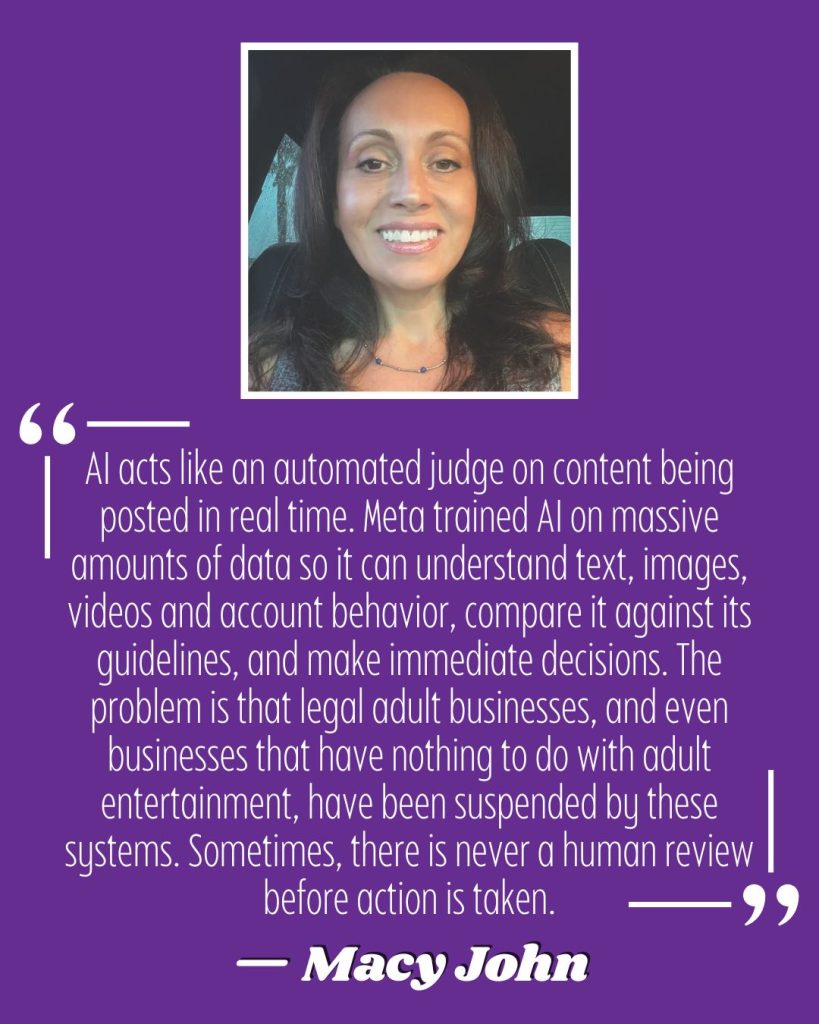
Seemingly harmless content can trigger restrictions if an algorithm interprets it as violating community standards. AI now acts as an automated judge, analyzing text, images, videos and even account behavior in real time. In many cases, businesses never receive an explanation beyond a generic notice that they’ve violated policies. Even more concerning, some accounts remain flagged even after owners completely change their content strategies.
“The problem is that legal adult businesses, and even businesses that have nothing to do with adult entertainment, have been suspended by these systems. Sometimes there is never a human review before action is taken.”
Many clubs and entertainers have been forced to rethink how they promote themselves online. At RCI, the strategy has shifted dramatically.
“We avoid images that focus on body parts, overly suggestive language and ‘dirty old man’ captions,” she explains, pointing out that RCI’s content now focuses on hospitality, entertainment, events, food and the overall experience instead of adult themes. “We’ve also written guidelines that every employee, contractor or marketing agency must read before they get access to our accounts.”
It’s a significant departure from the marketing approach many clubs relied upon for years. The industry’s challenge today isn’t simply avoiding violations. It’s learning how to promote a visually driven business while operating under restrictions that can often feel inconsistent and unclear.
For many clubs, social media has become less about selling fantasy and more about selling experience. That doesn’t guarantee Meta’s automated enforcers won’t target your account, though.
“Even if you clean up the page and posts, your account can still remain flagged under Account Integrity,” says John. “At this point, if you’ve lost an account that wasn’t actually violating policies, one of the best options is hiring an internet attorney to send a demand letter to Meta. Accounts do get restored, but it takes longer now because Meta is getting far more demand letters than they used to. This really only works if the account wasn’t problematic to begin with. There’s not much that can be done for accounts that violated their policies.”
While AI has complicated social media moderation, some believe it may also become one of the industry’s greatest tools. Pony Clubs’ head DJ Jeb Jarrell, who began experimenting with AI shortly after last year’s ED Expo, admits he initially felt overwhelmed.
“I was curious but honestly didn’t know where to begin,” he admits. “I don’t come from a technology background, and I certainly don’t consider myself an AI expert.”
Like many people who are new to AI technology, he started with widely available tools like ChatGPT, Claude, Gemini and Perplexity, gradually exploring how AI could simplify everyday tasks.
“I simply started by asking questions and solving little problems,” Jarrell explains. “I got comfortable quickly because I wasn’t trying to master AI overnight. I just kept finding new ways to make my life easier and my work more efficient.”
Today, AI touches nearly every aspect of his personal and professional life.
“Professionally, I’ve used AI to help develop my NEON DJ units, streamline music and video production, and assist with day-to-day operations,” he shares. “Personally, I use AI to help manage schedules, reminders, email, finances, home automation and even things like medication reminders. Over time, I’ve built a collection of AI assistants that help me stay organized and focused. For me, AI hasn’t replaced people—it has simply become another tool that helps me get more done.”
Jarrell believes AI can be a game changer for club marketing departments that are often stretched thin. Most club operators, he says, are already sitting on a goldmine of content. They just don’t know how to maximize it.
“AI can help operators turn a single event into multiple pieces of content across Facebook, Instagram, X, TikTok, email campaigns, recruiting posts and more,” he explains. “It can help with research, content calendars, graphic ideas, video concepts and even review posts for platform compliance before they’re published. The goal isn’t to replace creativity. It’s to help small teams work smarter and more consistently.”
Beyond social media, Jarrell also sees opportunities for AI solutions within other facets of club operations.
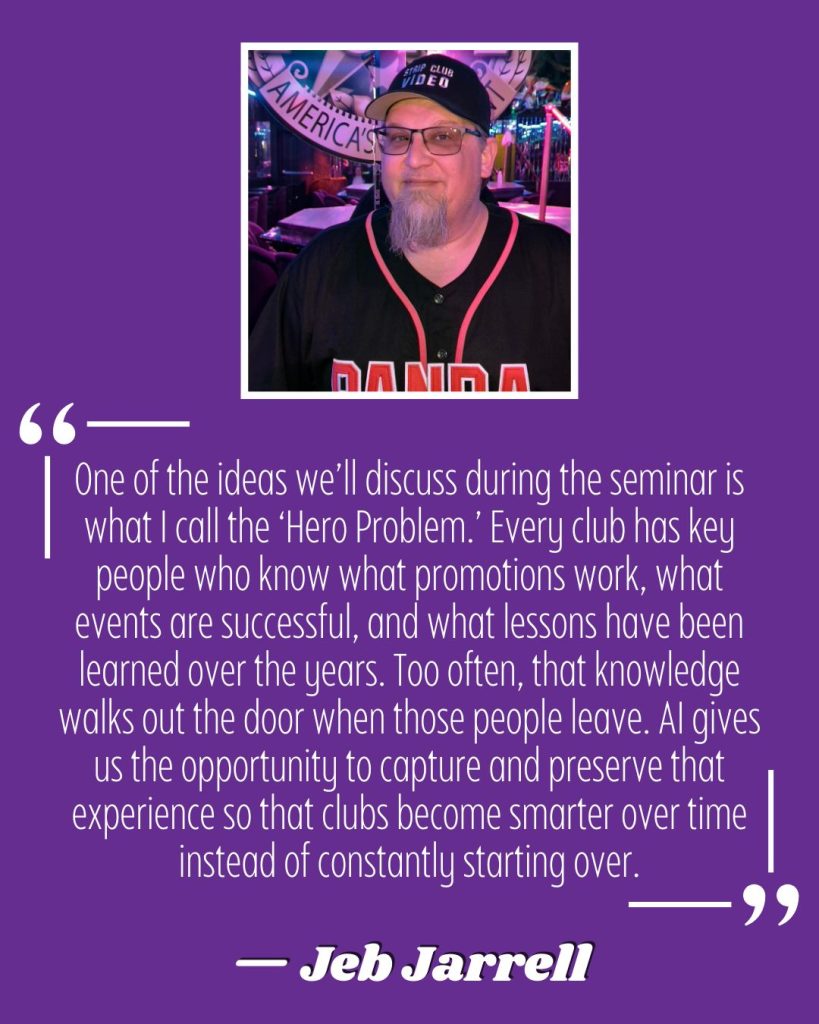
“One of the ideas we’ll discuss during this seminar is what I call the ‘Hero Problem.’ Every club has key people who know what promotions work, what events are successful and what lessons have been learned over the years. Too often, that knowledge walks out the door when those people leave.”
Rather than lose that knowledge, Jarrell will explain how using AI can capture and preserve it so that a club’s marketing strategy becomes smarter over time instead of having to repeatedly start over.
“I believe one of the biggest opportunities AI presents isn’t replacing people—it’s helping organizations learn faster and retain what they’ve already learned.”
The future of social media for the adult nightclub industry may be uncertain, but one thing is clear: adapting is no longer optional. For club owners, managers, entertainers, DJs, bartenders, marketing teams and really anyone on social media looking to survive and thrive in this new environment, don’t miss this year’s seminar “Reel to Real: How to Navigate a Very Restrictive Environment on Social Media.” Scheduled for Tuesday, August 25 at 10:30 am, this seminar promises to be one of the most timely and practical conversations at ED Expo 2026.